
I remember learning about Beta Pictoris in college. It was the poster child for planet formation. A young star, just 23 million years old, surrounded by a massive disk of dust and debris.
Two planets had been found there. Beta Pictoris b was one of the first exoplanets ever directly imaged . Beta Pictoris c followed later. We thought we knew this system well.
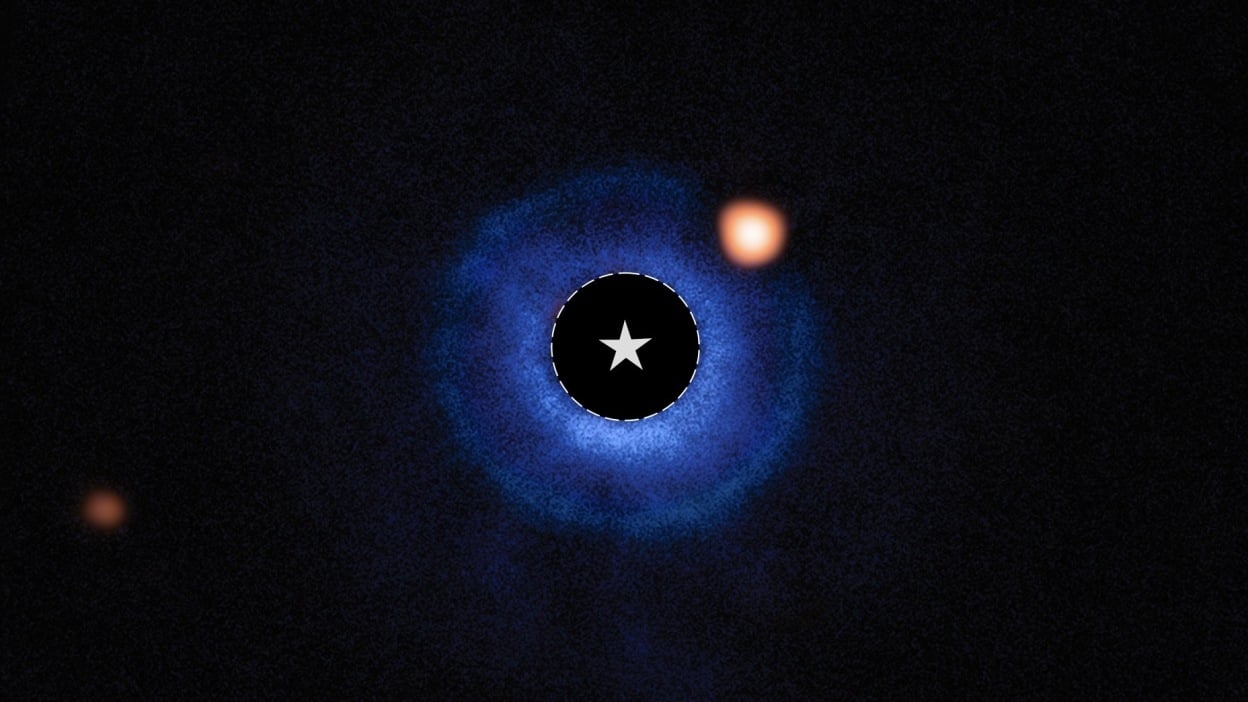
Now, NASA's James Webb Space Telescope has exposed a third planet hiding in plain sight. It remained hidden for over a decade, playing cosmic hide-and-seek within one of the brightest debris disks in the galaxy .
This discovery changes how we will find planets from now on.
The Accidental Discovery
The team was not looking for a new planet. They were studying Beta Pictoris b's atmosphere using Webb's NIRSpec instrument. The instrument captures both images and spectra from every pixel.
They expected to see a smooth spectrum from light bouncing off dust. Instead, they saw something strange.
Read Also: Viral Space View: NASA Drops Mind-Blowing Photo of the Milky Way Taken from the ISS
A series of peaks and troughs appeared in the data. It looked like a barcode. These were carbon monoxide absorption lines, a telltale signature of a giant planet atmosphere. The signal came from a location no one had predicted.
Astronomer Aidan Gibbs from UC San Diego put it plainly. "We weren't looking for a new planet," he said. "We were trying to understand one we already knew existed. Then, this telltale signal appeared in the data where we didn't expect it" .
The team was cautious. Bright blobs in images can be instrumental artifacts or disk structures . Webb's spectroscopic data confirmed it was no artifact. They measured the object's radial velocity, proving its position and motion matched a planet orbiting Beta Pictoris .
Follow-up observations with Webb's MIRI instrument detected water vapor and methane in its atmosphere. The planet was real .
What We Know About This New World?
The newly identified planet is named Beta Pictoris d . It is a gas giant at least twice the mass of Jupiter . That makes it the smallest of the three known planets in this system. Its orbit is about 30 astronomical units from its star, comparable to Neptune's distance from our Sun .
It is also the dimmest planet ever directly imaged from Earth, about 100 times fainter than Beta Pictoris b . An independent team using the European Southern Observatory's Very Large Telescope in Chile confirmed the discovery . They had been looking for the same planet for 11 years.
Markus Bonse of the European Southern Observatory described the challenge perfectly. "It was very much playing hide-and-seek for 11 years," he said .
The planet takes approximately 91 years to complete one orbit around its star . At a system age of just 23 million years, this planetary system is still a toddler compared to our 4.5 billion-year-old Solar System . Beta Pictoris offers a rare glimpse into a system still stabilizing from the chaos of its formation .
Why This Matters for Planet Hunting?
This discovery marks a milestone in astronomy. It is the first directly imaged planet discovered primarily through spectroscopy rather than conventional imaging.
You Must Also Like: 40 Years in the Making: ViaSat Prepares the ViaSat-3 F3 for Milestone Launch
The dusty disk around Beta Pictoris acts like fog. It scatters starlight, making traditional imaging difficult . Webb's spectroscopic method effectively ignored the dust, isolating narrow molecular signatures of the planet's atmosphere.
Astronomer Jean-Baptiste Ruffio described the power of this approach. "A spectrum contains an incredible amount of information," he said. "You don't just learn that something is a planet; you immediately begin learning about its temperature, chemistry, and motion" .
This technique could transform how we search for exoplanets. Future missions could detect planets hiding in complex environments by their atmospheric fingerprints instead of relying solely on bright points of light. This is particularly important as telescopes observe increasingly cluttered and dusty systems.
Solving a Long-Standing Puzzle
The discovery also explains a mystery that has baffled astronomers for years. Beta Pictoris has a debris disk with a sharply defined inner edge. Scientists had already predicted the existence of a planet like Beta Pictoris d to explain this structure.
Its gravitational influence is likely responsible for carving the disk's inner edge and clearing away leftovers from earlier stages of planet formation.
This connection between a discovered planet and a predicted structure validates models of planetary system evolution. The system is a laboratory for understanding how planets form and evolve .
Quick Summary
| Aspect | Details |
|---|---|
| Planet Name | Beta Pictoris d |
| Discovery Date | Announced July 15, 2026 |
| Telescope | NASA's James Webb Space Telescope |
| System Age | About 23 million years |
| Distance | 63 light-years from Earth |
| Mass | At least 2 times Jupiter's mass |
| Orbit | ~30 AU from star (comparable to Neptune) |
| Discovery Method | Spectroscopy (chemical fingerprints) |
| Significance | First exoplanet found primarily through moderate-resolution spectroscopy |
| Atmospheric Gases | Carbon monoxide, water vapor, methane |
Final Thoughts
This discovery changes how we see the universe. Beta Pictoris d is not a bright, obvious planet. It is a faint world, hidden for over a decade by the glare of its own star system.
The fact that we found it through spectroscopy, not imaging, opens a new window into the cosmos. Future telescopes can now look for the chemical "barcodes" of exoplanets rather than just their light.
The Beta Pictoris system just got more interesting. And our search for worlds beyond our solar system just got smarter.