
Four astronauts woke up on April 5, 2026, roughly 215,000 miles from Earth. No land in sight. Just blackness and a growing white ball ahead.
Artemis II Flight Day 5: Correction Burn Complete is the official NASA headline. But the real story is simpler. The crew tested their survival suits. They checked their science targets. They fired thrusters for 17.5 seconds to stay on course.
Everything worked.
Here is what actually happened up there. No hype. Just the facts.
The Correction Burn: 17.5 Seconds That Matter
Mission control in Houston told the crew to fire the thrusters at 11:03 p.m. Eastern on April 5.
The burn lasted 17.5 seconds.
Read Also: NASA Shares Progress on National Space Policy Implementation
That is shorter than most TV commercials. But in space, 17 seconds changes everything. The burn refined Orion's path toward the Moon. Without it, the spacecraft drifts. With it, the trajectory stays tight.
Earlier in the mission, NASA cancelled two planned correction burns. Why? Because Orion was already flying exactly where it needed to go. That is rare. That is good engineering.
What this means for the mission: The spacecraft is behaving better than expected. That lowers risk for the crew. That is the best news you can get on Flight Day 5.
The Suit Test: Not Glamorous. Absolutely Critical.
Here is something most news articles skip.
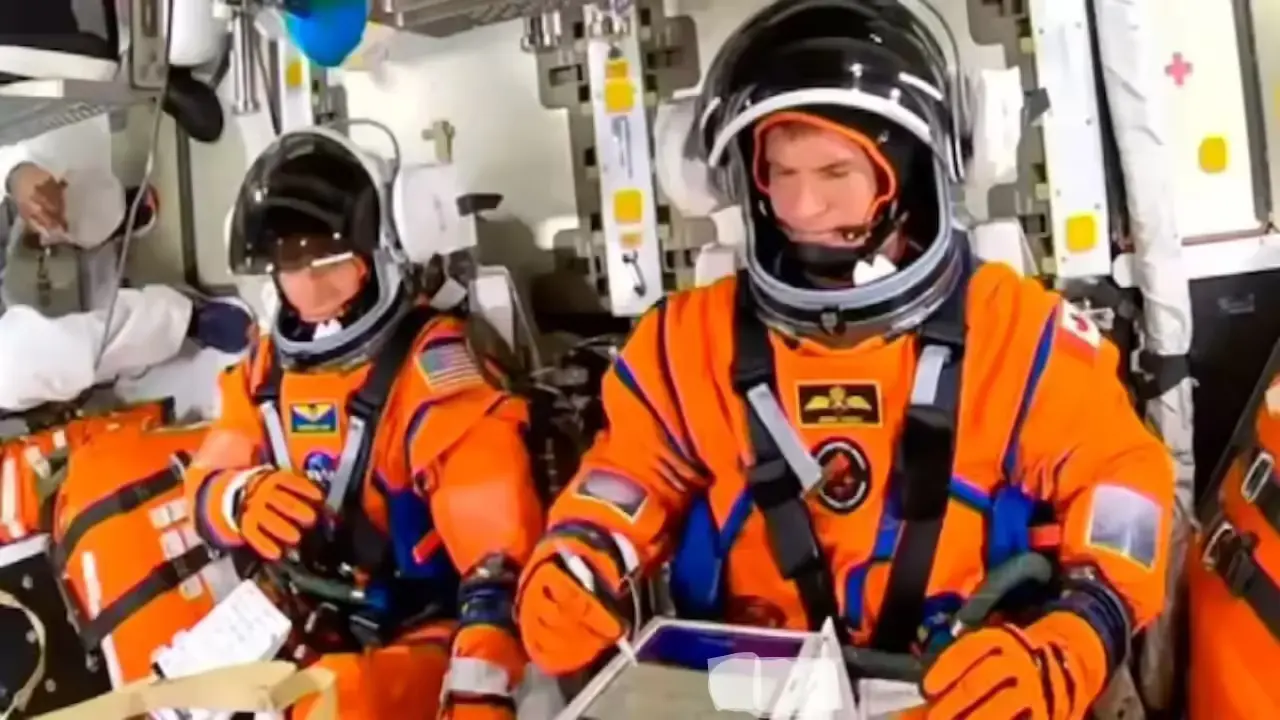
On Flight Day 5, all four crew members put on their Orion Crew Survival System suits. Not for launch. Not for landing. For testing.
They pressurized the suits. They checked for leaks. They simulated sitting in their seats. They tried to eat and drink while wearing them.
Sounds simple. It is not.
I have talked to astronauts who say the suit test is one of the most annoying days of training. The suits are stiff. They restrict movement. Eating a space meal with thick gloves on is like trying to eat soup with ski gloves.
But here is why the test matters.
If the cabin loses pressure, that suit is the only thing keeping the astronaut alive. It provides oxygen. It maintains pressure. It keeps body temperature stable.
NASA ran this test on Flight Day 5 because the crew is still close enough to Earth to abort if something fails. Smart planning.
The result: No major issues reported. The suits work.
The Crew: Four Humans, One Mission
Let me tell you who is on this spacecraft. Because their backgrounds matter.

Reid Wiseman is the commander. He is 50 years old. He flew a 165-day mission to the International Space Station in 2014. He lost his wife to cancer in 2020. He raised two daughters alone. Before launch, he showed them where the will is and where the trust documents are. That is not drama. That is honesty.
Victor Glover is the pilot. He is 49. He will be the first Black man to travel to the Moon. In 2020, he became the first African American to live on the space station for a long-duration mission. He calls himself a "Navy kid at heart."
Christina Koch is a mission specialist. She holds the record for the longest single spaceflight by a woman: 328 days. She also did the first all-female spacewalk in 2019. Her personal motto? "Do what scares you".
Jeremy Hansen is the other mission specialist. He is Canadian. He is 50. This is his first trip to space. He spent years working as a capsule communicator in mission control. Now he is sitting in the capsule. He will be the first non-American to fly around the Moon.
Artemis 2 crew nationality breakdown: Three Americans. One Canadian. Simple.
The Science Targets: What They Are Looking At
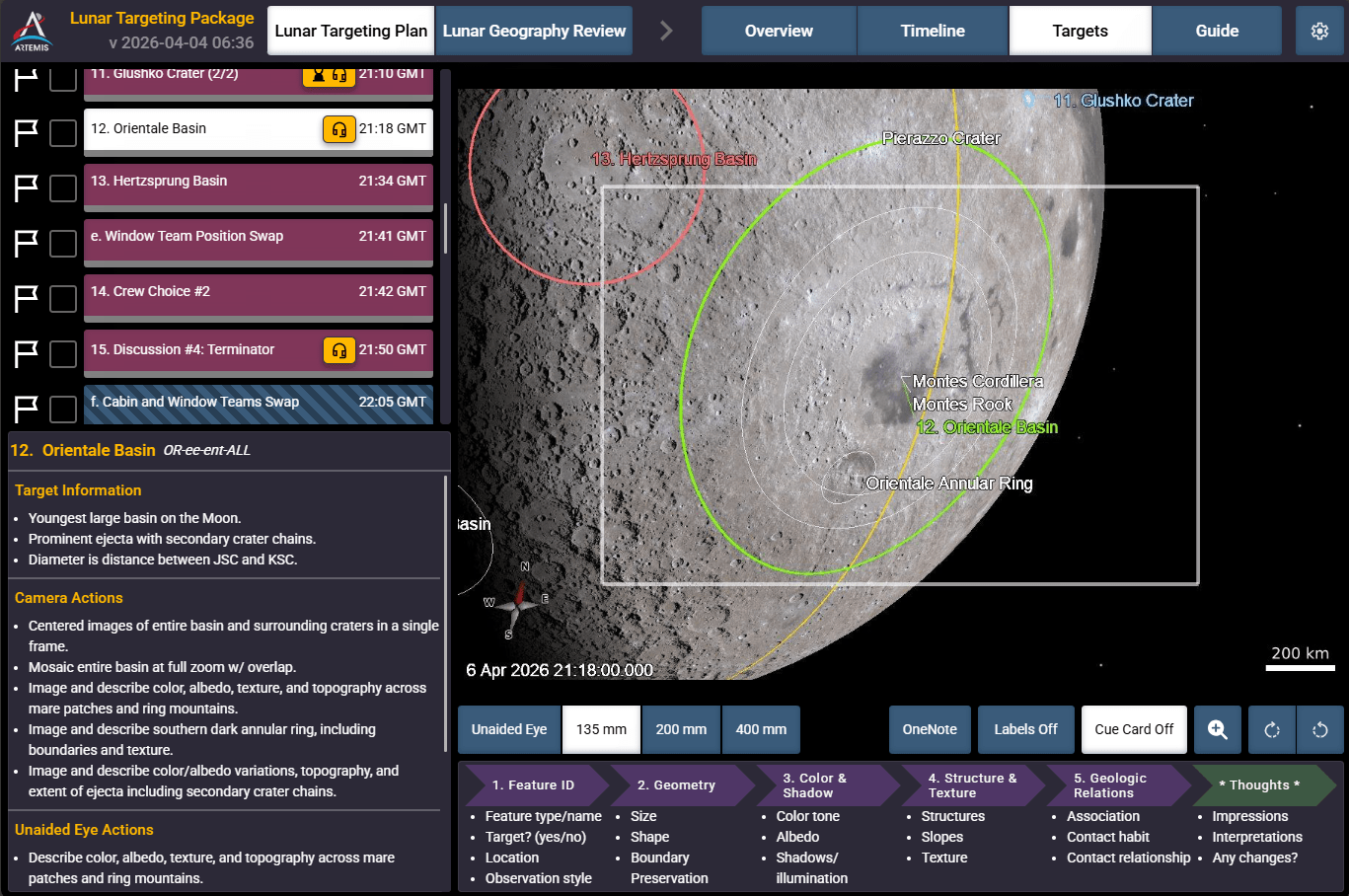
NASA sent the crew their final science targets early on Flight Day 5.
Thirty specific locations on the Moon. All of them on the far side. All of them never seen by human eyes before.
Two craters are the stars of the show.
The Orientale basin. This thing is nearly 600 miles wide. It formed 3.8 billion years ago when something huge slammed into the Moon. The impact left rings. Like a bullseye on the lunar surface. The crew will see it fully illuminated as they approach.
The Hertzsprung basin. This one is on the far side. About 400 miles wide. Older than Orientale. More beaten up. More craters on top of craters.
Why both? Comparison. Orientale is fresh. Hertzsprung is old. By looking at both, scientists learn how the Moon's surface changes over billions of years.
Artemis II crew mission details include photography. Lots of it. The astronauts will shoot high-resolution images of these craters. Geologists on Earth will study those images for months.
The Big Milestone Coming: Breaking Apollo 13's Record
Flight Day 5 set the table. Flight Day 6 serves the main course.
At 1:56 p.m. Eastern on April 6, the Artemis II crew will surpass the farthest distance from Earth ever traveled by humans.
You Must Also Like: Air Traffic Management and Safety Project Explained
The current record belongs to Apollo 13. That crew reached 248,655 miles from Earth in 1970. They were supposed to land on the Moon. An oxygen tank exploded. They barely made it home.
Artemis II will hit 252,757 miles. Then they will keep going.
What this means: This is not a repeat of Apollo. This is going further. This is testing the limits of Orion. This is proving that humans can go deeper into space than ever before.
The Lunar Flyby: What Actually Happens
Here is the timeline for April 6. All times Eastern.
12:41 a.m. – Orion enters the Moon's sphere of influence. The Moon's gravity becomes the boss.
1:56 p.m. – Distance record broken.
2:45 p.m. – Lunar observations begin. The crew starts shooting photos.
6:44 p.m. – Loss of signal. The spacecraft passes behind the Moon. No communication for about 40 minutes.
7:02 p.m. – Closest approach. Orion flies 4,070 miles above the lunar surface.
7:07 p.m. – Maximum distance from Earth. 252,757 miles.
7:25 p.m. – Signal returns. Earthrise.
8:35 p.m. to 9:32 p.m. – Solar eclipse. The Sun passes behind the Moon from the crew's perspective.
9:20 p.m. – Lunar observations end.
The crew will see things no human has ever seen. The far side of the Moon. Close up. In real time. With their own eyes.
What NASA Is Watching Closely
NASA Administrator Jared Isaacman was honest before launch. He told reporters this is the most dangerous human spaceflight mission in 53 years.
Why? Because once you commit to going to the Moon, you cannot come home in hours. The space station is 250 miles up. The Moon is 250,000 miles up. Big difference.
Artemis 2 crew Victor Glover will be the one manually flying Orion if something goes wrong. He already tested manual control earlier in the mission. His verdict? "This flies very nicely.
That is pilot speak for "I am not worried."
The CubeSats: Small Satellites, Big Science
Nobody is talking about the CubeSats. But they matter.
Four small satellites hitched a ride on Artemis II. They released shortly after launch.
Germany sent TACHELES. It tests how electronics behave in space radiation.
South Korea sent K-Rad Cube. It carries human-like tissue to measure radiation exposure across the Van Allen belts.
Saudi Arabia sent a satellite to monitor solar particles.
Argentina sent ATENEA to test shielding and long-range communication.
These are not afterthoughts. They are the science payload. While the astronauts fly around the Moon, these little machines are collecting data that will protect future crews.
What Comes After Flight Day 5
The crew sleeps at 2:20 a.m. on April 6. They wake up at 10:50 a.m..
Then the flyby happens.
After that, Orion swings around the Moon and heads home. Splashdown is targeted for April 10 or 11 off the coast of San Diego.
The spacecraft will hit the atmosphere at nearly 25,000 miles per hour. The heat shield will see temperatures close to 3,000 degrees Fahrenheit. Eight parachutes will deploy. Airbags will keep the capsule upright.
Then the crew comes home.
The Honest Assessment: Pros and Cons
Pros:
-
Orion is performing better than expected. Two cancelled correction burns prove that.
-
The crew is healthy. The suits work. Life support works.
-
NASA is streaming everything. You can watch on NASA+, Amazon Prime, Apple TV, Hulu, Netflix, HBO Max, and YouTube.
-
The science is solid. Thirty lunar targets. Four CubeSat experiments. Real data coming back.
Cons:
-
This is still a test flight. Things can fail. The heat shield had issues on Artemis I.
-
The crew is exposed to deep space radiation. No way around that.
-
Budget uncertainty. The White House proposed cuts to NASA. Congress will fight about it.
Who this mission is for: Engineers who need data. Scientists who need photos. Kids who need to see that humans can still do big things.
Who this mission is not for: People who want a lunar landing. That is Artemis IV in 2028. Be patient.
Final Word
Artemis II Flight Day 5: Correction Burn Complete is not a flashy headline.
It is not a moon landing. It is not a spacewalk. It is not a crisis.
It is four people in a can, 215,000 miles from home, testing suits and checking lists and firing thrusters for 17 seconds.
That is how you fly to the Moon. One boring, perfect day at a time.
Tomorrow they break the record. Tomorrow they see the far side.
But today? Today they did the work.
Where to Watch the Lunar Flyby (April 6, 1 p.m. Eastern):
NASA+ | Amazon Prime | Apple TV | Hulu | Netflix | HBO Max | Roku | NASA YouTube
Follow real-time updates: @NASAArtemis on X, Facebook, Instagram
Artemis II crew mission details are on NASA's website. So are the photos. Go look at them. They are worth your time.