
You have heard the horror stories. Chernobyl. Fukushima. Three Mile Island.
Each disaster involved the same thing: a solid uranium fuel core that lost cooling, overheated, and melted down. But what if a reactor could not melt down? What if the fuel itself prevented the disaster?
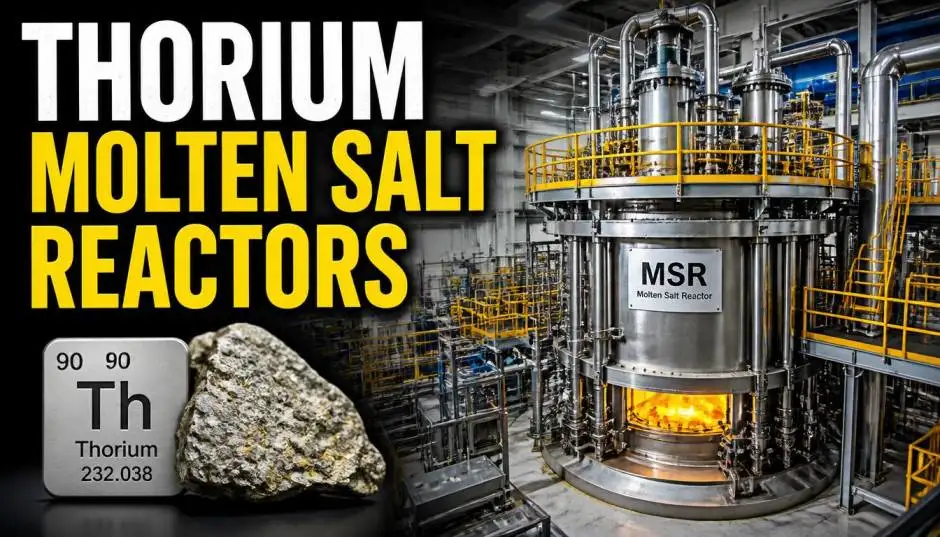
That is the promise of Thorium Molten Salt Reactors.
Instead of solid fuel rods, these reactors dissolve thorium in hot liquid salt. No high pressure. No continuous pumping required. And a clever safety device called a "freeze plug" that melts if the reactor gets too hot, draining the fuel into a safe tank below.
This is not science fiction. China is currently operating the world's first thorium molten salt reactor in the Gobi Desert. Europe and North America are racing to catch up.
Let me walk you through exactly how this works, why it matters, and what the real limitations are.
How Does a Molten Salt Reactor Work?
Stop thinking about nuclear reactors the old way.
Traditional reactors pack solid uranium pellets into metal rods. Water flows past to cool them. If the water stops, the rods overheat and melt. Simple.
Read Also: Quantum Scrambling Reversal: Latest Breakthroughs Explained
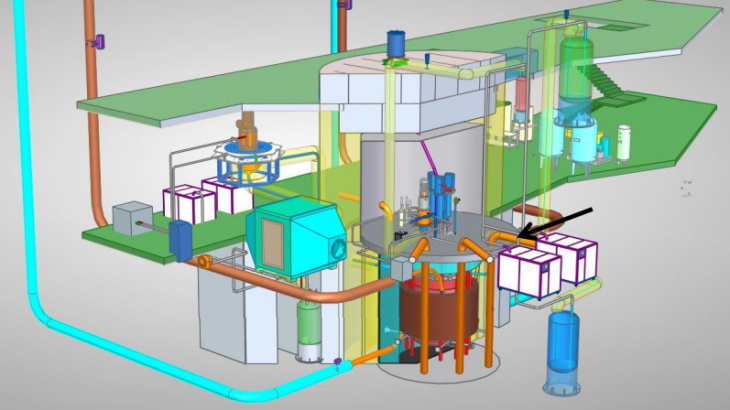
A molten salt reactor flips this completely. No rods. No high-pressure water. No risk of the fuel "melting" because it is already liquid. Here is the beautiful part. The salt itself acts as the coolant.
If the reactor gets too hot, the salt expands. That expansion pushes fuel atoms apart, which naturally slows the nuclear reaction. It self-regulates. No operator needed.
The Freeze Plug: Your New Favorite Safety Device
Let me tell you about the most important piece of metal you have never heard of.
At the bottom of a thorium molten salt reactor sits a frozen salt plug. A cooling fan keeps it solid. The entire reactor's liquid fuel sits above it, held back by this single frozen plug.
Now imagine something goes wrong. Power failure. Pump breakdown. Operator error.
The cooling fan stops. The frozen plug warms up. It melts.
Gravity takes over. The liquid fuel drains into a specially designed drain tank below. This tank is shaped to spread the fuel into a thin, non-critical layer where the nuclear reaction cannot restart.
No pumps. No backup generators. No human pressing buttons.
Physics handles everything.
This is what engineers call "passive safety." The reactor does not need active systems to stay safe. It just obeys the laws of nature.
Are Molten Salt Reactors Radioactive?
Yes. Let me be completely straight with you.
Thorium Molten Salt Reactors are absolutely radioactive.
Anyone who tells you otherwise is selling something. But here is the crucial difference. The radioactivity behaves differently. In a traditional reactor meltdown, the solid fuel cladding fails. Radioactive gases burst out.
You Must Also Like: The Move From Theoretical Quantum to Practical Quantum Computing
The fuel itself turns into a molten mass that burns through concrete.
In a molten salt reactor, the fuel is already liquid. A "meltdown" just means the liquid drains into the drain tank. No explosion. No burning through the ground. The radioactive material stays inside its containment.
Thorium Molten Salt Reactors Facts: What You Need to Know?
Let me give you the straight facts. No hype. No fear-mongering.
Fact One: Thorium is abundant. Three to four times more common in the earth's crust than uranium. Major deposits exist in India, Brazil, Australia, the United States, and China.
Fact Two: The technology is not new. Oak Ridge National Laboratory ran a molten salt reactor experiment from 1965 to 1969 . It worked fine. The program got cancelled for political reasons, not technical ones.
Fact Three: China currently leads. Their TMSR-LF1 reactor in the Gobi Desert achieved criticality in 2023 and reached full power in 2024 . It is small (only 2 megawatts), but it proves the concept works.
Fact Four: Materials still struggle. Hot liquid salt corrodes pipes and valves. Oak Ridge spent years fighting this problem in the 1960s. Modern alloys are better, but corrosion remains a challenge for long-term operation.
Real World Status: Who Is Building These Things?
Here is where things get interesting.
China already operates the TMSR-LF1. They are planning a much larger version for the 2030s.
The Netherlands and France are working together on the Thorizon One reactor. This 100 megawatt design targets industrial customers who need high-temperature heat for chemical plants and steel manufacturing. They aim to start construction by 2030.
Denmark's Copenhagen Atomics just announced a critical experiment with Switzerland's Paul Scherrer Institute scheduled for 2026-2027. Their design uses replaceable core cartridges to solve the corrosion problem.
South Korea's Hyundai Engineering has partnered with Thorizon to handle construction. They bring serious nuclear building experience to the table.
The Honest Limitations Nobody Wants to Admit
I have given you the promise. Now let me give you the problems.
Corrosion is real. Liquid fluoride salt at 700 degrees Celsius eats through standard alloys. Oak Ridge had to develop special materials . Modern solutions exist but add cost and complexity.
The freeze plug has failure modes. What if debris blocks the drain line? What if the plug fails to melt evenly? Engineers have thought about these scenarios. Multiple drain paths and intentionally weaker vessel sections provide backup. But these add engineering complexity.
Online reprocessing is hard. To make thorium work efficiently, you need to continuously remove fission products from the liquid salt and add fresh fuel. This is technically demanding. Nobody has done it at commercial scale.
Regulatory paths are unclear. Every existing nuclear license assumes solid fuel rods. Molten salt reactors do not fit neatly into any existing regulatory framework. Getting approved will take years and millions of dollars.
Startup requires enriched uranium. Thorium itself will not start the chain reaction. You need a fissile "seed" usually uranium-235 or plutonium to kick things off. This creates proliferation concerns for the initial fuel load.
Who Should Pay Attention to This Technology?
Let me give you practical guidance.
These reactors run at 550-600 degrees Celsius perfect for industrial use.
Skeptics should remain skeptical until someone builds a commercial version that runs for five years without major component replacement.
What The Anti-Nuclear Crowd Gets Wrong?
I hear the arguments. "Nuclear waste is dangerous." "Chernobyl proved reactors can explode."
Those concerns apply to solid-fuel, water-cooled reactors.
Thorium molten salt reactors produce waste with shorter half-lives. The really dangerous transuranic elements get burned as fuel rather than becoming waste.
And an explosion? The reactor operates at atmospheric pressure. Nothing to explode. The worst realistic accident is a leak, which would spill radioactive salt onto the floor where it would cool and solidify.
Is that ideal? No. Is it a Chernobyl-level catastrophe? Absolutely not.
The Final Thoughts
The genius of Thorium Molten Salt Reactors is not complicated technology. It is simple physics. Hot salt expands, slowing the reaction. A frozen plug melts, draining the fuel. Gravity moves things to a safe place.
No active safety systems. No human decisions. No pumps that can fail. The reactor literally cannot melt down because the fuel is already liquid. The worst case is a drain and solidify.
China has proven the concept works. Europe is building the first commercial designs. The remaining challenges corrosion, reprocessing, regulation are engineering problems, not physics problems.