
I have been watching this telescope get built for years. Not literally. I do not work at NASA. But I follow space news like some people follow sports. Every update. Every test. Every delay.
Now it is finally real.
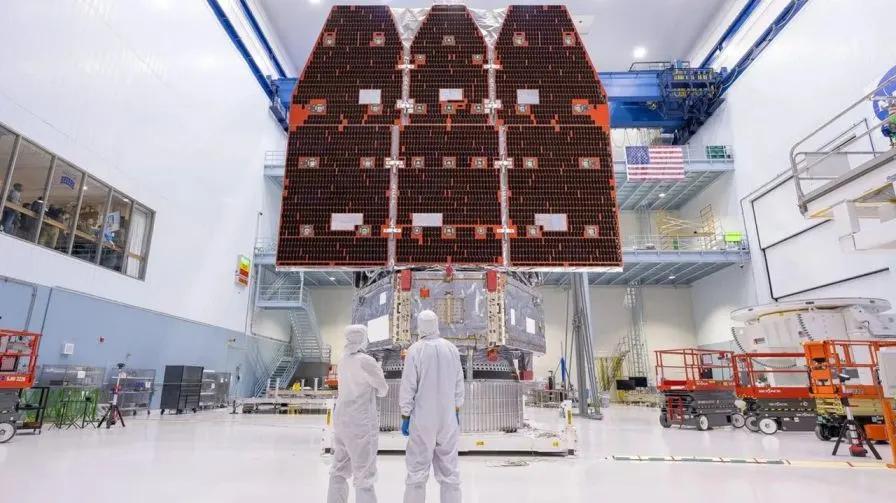
The Nancy Grace Roman Space Telescope is fully assembled. It passed its final tests. It is sitting in a clean room at NASA's Goddard Space Flight Center in Greenbelt, Maryland, waiting to ship out.
The telescope looks ready. Shiny. Silver. But here is the thing about space launches. They slip. Delays happen.
What Is the Nancy Grace Roman Space Telescope?
The Nancy Grace Roman Space Telescope is NASA's next flagship observatory. It follows the lineage of Hubble (1990) and Webb (2021). But Roman is different.
Read Also: Planet Earth Is Vast: How Small Humans Truly Are
Hubble sees deep but narrow. Webb sees deeper but narrower. Roman sees wide. Really wide. Its field of view is 100 times larger than Hubble's. One Roman image captures as much detail as 100 Hubble images.
Think of it this way. Hubble looks through a drinking straw. Roman looks through a picture window. NASA calls Roman "Hubble's wide-eyed cousin". That is the best description I have heard.
Roman vs James Webb – Two Very Different Tools
Everyone asks me this. How does Roman compare to James Webb? The Nancy Grace Roman Space Telescope vs James Webb comparison is not about which is better. They do different jobs.
Webb has a giant mirror. Ultracold instruments. Infrared vision. It looks at the farthest, oldest parts of the universe. It sees individual galaxies in incredible detail.
Roman has a large field of view. It captures giant 300-megapixel images. It surveys the sky 1,000 times faster than Hubble. It finds things. Then Webb can zoom in on them.
Roman finds the needles. Webb studies the haystack.
Julie McEnery, Roman's senior project scientist, put it this way. Roman's much larger field of view will reveal many such objects that were previously unknown.
Since we've never had an observatory like this scanning the cosmos before, we could even find entirely new classes of objects and events.
That is exciting.
Why Is It Called the Nancy Grace Roman Space Telescope?
I had to look this up when I first heard the name. Why is it called the Nancy Grace Roman Space Telescope? The answer is simple. She earned it. Nancy Grace Roman was NASA's first chief astronomer. The first woman to hold an executive position at the space agency.
She is called the Mother of Hubble. She championed the Hubble Space Telescope when almost no one believed it could work. She fought for funding. She convinced Congress. She made Hubble happen.
You Must Also Like: Nvidia Announces Space-1 Vera Rubin Module for Orbital Data Centers
In a 2000 oral history interview, Roman talked about her Southern roots. She was born in Nashville, Tennessee. Her family used double names. She went by Nancy Grace as a child.
She dropped the double name in graduate school because Northerners could not handle it. Then decades later, she brought it back. A summer student used her double name, and Roman thought, "If she used it, why can't I?"
She died in 2018 at age 93. She did not live to see Roman launch. But her name will be attached to discoveries we cannot even imagine yet.
That is a legacy.
What Will Roman Actually Do Up There?
Roman will orbit about 930,000 miles from Earth. Four times farther than the Moon. At the Sun-Earth Lagrange Point L2, same as Webb. From that position, Roman will study three big things.
Dark Energy and Dark Matter
These two things make up 95 percent of the universe. We cannot see them. We barely understand them. Roman will map hundreds of millions of galaxies.
It will measure how the universe expanded over time. That data will help scientists figure out what dark energy actually is.
Roman is designed to try and understand the forces that are driving that acceleration.
Surveying the Entire Sky
Roman will produce 500 terabytes of data every year. That is a lot. One month of Roman observations equals a century with Hubble.
NASA Administrator Jared Isaacman said, The images it captures will be so large there is not a screen in existence large enough to show them. Roman will give the Earth a new atlas of the universe.
That is not hype. That is just the math.
The Launch Timeline – September or Later?
Here is the honest truth about the schedule.
NASA says Roman is on track for launch as early as September 2026. The telescope is fully assembled. Final tests are done. It will ship to Kennedy Space Center in Florida soon.
But NASA also gives a "no later than" date of May 2027 . That is the official buffer. Why the uncertainty? Two reasons. First, rockets. SpaceX Falcon Heavy is reliable. But launch slots get delayed. Weather happens. Technical issues happen.
Second, final preparations at Kennedy Space Center take time. The telescope needs to be mated to the rocket. Fueled. Tested again.
I have followed enough launches to know. Do not book travel for September. Wait for the firm date.
Who Built Roman and Where?
Roman was assembled at NASA's Goddard Space Flight Center in Greenbelt, Maryland. About 1,000 people worked on it at the peak. Government employees and contractors. Engineers. Scientists. Technicians.
Jackie Townsend, a deputy project manager at Goddard, grew up in Maryland. She lives in Silver Spring now. She told a reporter, At first, it feels like a marching army.
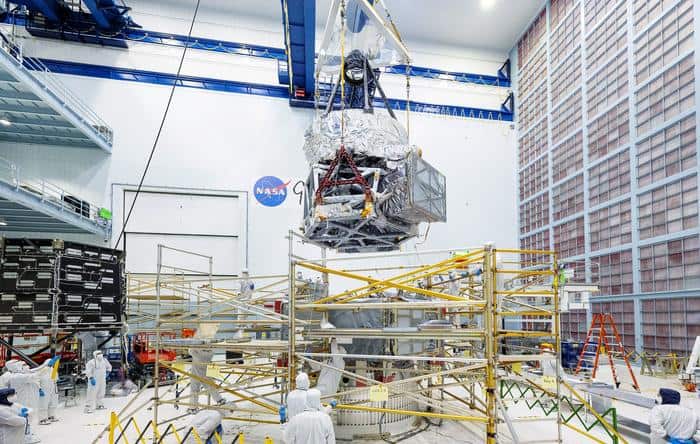
The telescope's parts came from all over. But final assembly happened in a "clean room" at Goddard. That room is so clean you have to wear a full-body suit just to enter.
Once Roman launches, Goddard will still be home. The mission operations center is there. Every time NASA talks to Roman, the signal goes through Greenbelt.
What About the Cost?
Roman cost more than $4 billion to develop. That sounds like a lot. But here is the surprising part. NASA Administrator Jared Isaacman said the mission is ahead of schedule and below budget.
That almost never happens with big space telescopes.
Webb was famously over budget and years late. Hubble had a flawed mirror that needed a repair mission. Roman avoided those problems.
The telescope was originally called WFIRST (Wide-Field Infrared Survey Telescope). It got renamed in 2020 to honor Nancy Grace Roman.
The name change was the least expensive part of the mission.
When Will We See the First Images?
Roman launches in September (hopefully). Then it needs time to travel to L2. That takes about 30 days. Then commissioning begins. Engineers test every instrument. Calibrate every sensor. Make sure nothing broke during launch.
The first images should come back to Earth in December 2026. If everything goes right.
I will be watching for those first images like everyone else. If they are anything like Webb's first images, they will break the internet.
Summary Table – Roman vs Hubble vs Webb
| Feature | Roman | Hubble | Webb |
|---|---|---|---|
| Launch Year | 2026 | 1990 | 2021 |
| Primary Mirror | 2.4m | 2.4m | 6.5m |
| Field of View | 100x Hubble | 1x | ~1/10th Hubble |
| Orbit | L2 (930k miles) | Low Earth Orbit | L2 |
| Key Mission | Dark energy, exoplanet survey | Deep field, universe age | First galaxies, star formation |
| Wavelength | Visible + Near-IR | Visible + UV + Near-IR | Near-IR + Mid-IR |
| Cost | $4B+ | $16B (lifetime) | $10B |
My Take – Why Roman Matters?
I have been following space telescopes for 20 years. Hubble was my gateway. Webb blew my mind. Roman is different. Webb shows us the most distant galaxies. Hubble shows us beautiful nebulae. Roman will show us the map.
A billion galaxies mapped across the sky. Transient events captured in real time. Exploding stars. Colliding neutron stars. Planets being born. Roman will find things we did not even know to look for.
That is the best part of any new telescope. The surprises. I will be watching the launch. Probably from my couch. Probably with coffee. Probably nervous. But I will be watching.
And in December, when the first images drop, I will be right there. Staring at my screen. Mouth open. Same as everyone else.